
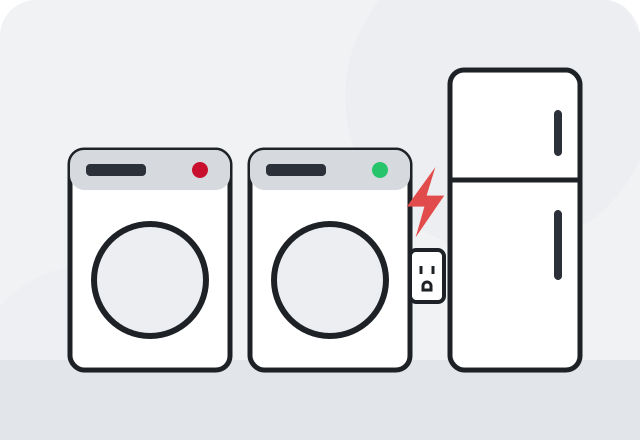
What homeowners usually notice
- The kitchen goes quiet and the fridge light is off, with a tripped breaker or GFCI.
- Trips happen at random times, sometimes overnight, often during the defrost cycle.
- The fridge clicks, tries to start the compressor, then everything shuts off.
- Trips began after the fridge was moved, a new one was delivered, or the kitchen was updated.
What to do right now
- Keep the doors shut to hold the cold while you sort it out.
- Reset the tripped breaker or GFCI once.
- If it trips again, plug the fridge into a heavy-duty outlet on a different circuit using a properly rated cord, as a short-term measure only.
- Check for water pooled under or behind the fridge.
Likely causes
Compressor or start relay failing
A compressor that struggles to start can draw heavy current or leak current to ground. This is an appliance repair job.
Defrost heater or water leak
Self-defrosting refrigerators run a heater on a timer. A cracked heater or melt water reaching wiring inside the fridge commonly trips GFCIs during defrost.
Shared circuit
When the fridge shares a circuit with a microwave, toaster oven or countertop outlets, the combined load can trip the breaker when everything runs at once.
GFCI or AFCI interaction
Current code requires GFCI or AFCI protection in many kitchen locations. A healthy fridge usually runs fine on them, but an aging compressor with a slight leak to ground will trip them. It is a clue, not a reason to remove the protection.
Worn outlet or loose connection
The outlet behind a fridge rarely gets looked at. A loose or worn outlet can heat up under that steady load.
Safe checks you can make
- Note the time of each trip; trips on a regular cycle often line up with defrost.
- Try the fridge on a different circuit and see whether trips follow it.
- Look at the cord and plug for kinks, flattening or discoloration from being pinched against the wall.
- Check whether the tripping device is a GFCI outlet, a GFCI breaker, an AFCI breaker or a standard breaker.
Leave outlet covers, switch plates and the panel cover in place. Noting what you see and hear is enough; testing inside boxes belongs to an electrician.
Is this something you can fix yourself?
The plug-it-elsewhere test is the honest answer here. If the fridge trips a different circuit too, the fault is inside the refrigerator, and an appliance repair technician should look at the compressor, defrost system and internal wiring. If it runs fine elsewhere, the original circuit is the problem, and that is electrical. Please do not replace a GFCI with a plain outlet or plug the fridge into an ungrounded adapter to stop the trips. Those devices are protecting you, and the trips mean something is leaking current.
When professional help is the right call
- The fridge runs fine on other circuits but trips its usual one.
- The outlet behind the fridge is warm, darkened or smells burnt.
- The fridge shares a circuit with the microwave or countertop outlets and trips during meal prep.
- A new refrigerator trips a circuit the old one never did.
Safety first. Stop using the outlet if it is hot or scorched, and call an electrician. If you smell burning plastic from behind the fridge or see smoke, unplug it only if you can do so safely, leave the house if it continues, and call 911.

What an electrician typically checks
An electrician will check whether the refrigerator has the dedicated circuit many kitchens call for, test the GFCI or AFCI device, and inspect the outlet and wiring for heat damage. If the fridge shares a circuit with countertop loads, they can explain options for splitting it.
When the fridge is the problem, the electrician will tell you so, and you can hand off to an appliance repair technician. For the electrical side, see outlet repair and how AFCI protection works.
Keeping it from coming back
Keep the fridge on its own outlet with no power strip or adapter, leave a little space so the cord is not crushed, and vacuum the condenser coils a couple of times a year so the compressor does not overwork in a warm kitchen.