
What homeowners usually notice
- One outlet on a wall is dead while the one a few feet away works normally.
- Only the top or bottom half of a single outlet has power.
- The outlet works some days and not others, or flickers on when you wiggle the plug.
- A lamp plugged into the dead outlet comes on when you flip a wall switch.
What to do right now
- Plug a lamp you know works into the dead outlet, then try the wall switches in the room.
- Look for a GFCI outlet (the kind with test and reset buttons) in nearby bathrooms, the kitchen, garage, laundry or outside, and press reset.
- Check the breaker panel for any breaker sitting in the middle or off position and reset it once.
- If the outlet shows any scorching or smells hot, stop using it and leave it unplugged.
Likely causes
Tripped GFCI upstream
A single GFCI in a bathroom or garage often protects other outlets in different rooms. When it trips, those outlets go dead while everything else keeps working.
Switched outlet
Many bedrooms and living rooms have an outlet, or half of one, wired to a wall switch so a lamp can be turned on at the door.
Loose connection at a neighboring outlet
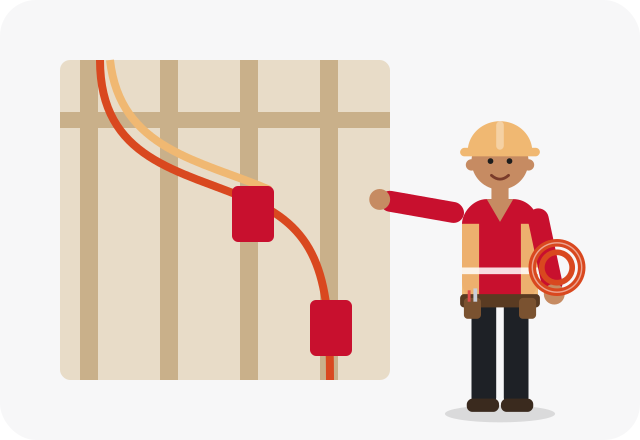
Outlets are often chained, with power passing through one to reach the next. A loose wire or failed push-in connection at the working outlet can leave the next one dead.
Worn-out receptacle
The contacts inside an old outlet can lose tension or break, so plugs make poor contact or none at all.
Split or damaged wiring
Some outlets are wired so each half is on a different circuit or switch. A broken tab or damaged cable can leave half the outlet dead.
Safe checks you can make
- Test each half of the dead outlet separately with the same lamp.
- Map which other outlets or lights in the area also lost power.
- Note whether the problem started after a storm, a remodel, or plugging in something heavy.
- Feel the cover plate of the working outlet next to it. Warmth is a warning sign.
Leave outlet covers, switch plates and the panel cover in place. Noting what you see and hear is enough; testing inside boxes belongs to an electrician.
Is this something you can fix yourself?
This is one of the problems homeowners often solve on their own. Pressing reset on a tripped GFCI in another room, or discovering that a wall switch controls the outlet, takes care of a large share of these calls. If the outlet has two halves and only one works, try the switches before assuming anything is broken. What is not a do-it-yourself job is opening the outlet or the neighboring one to tighten connections. Loose wires on a chained circuit need to be repaired properly, often by moving them off push-in terminals, and that work belongs with an electrician offering outlet repair.
When professional help is the right call
- No GFCI, switch or breaker brings the outlet back.
- The working outlet next to it is warm, discolored or crackles.
- The dead outlet comes and goes when something is plugged in or bumped.
- More outlets on the same wall have started failing over time.
Safety first. Stop using both the dead outlet and its neighbors if you notice a burning smell, buzzing, or brown marks on a cover plate. Those are signs of arcing at a loose connection. If you see smoke or flame, leave the house and call 911.

What an electrician typically checks
An electrician will usually trace the circuit to find which outlet feeds the dead one, then check each connection with the power off. Push-in (backstab) connections are a frequent weak point, and moving wires to the screw terminals or replacing the receptacle often restores power.
They also check whether the outlet is meant to be switched, whether the GFCI protection is set up correctly, and whether the wiring shows signs of heat damage that would call for a wider look at the circuit.
Keeping it from coming back
Avoid heavy loads on outlets that feel loose, and replace receptacles that no longer grip plugs firmly. Label which GFCI protects which outlets so the next time something goes dead in the living room you know to check the bathroom. In older Birmingham neighborhoods like Crestwood or Norwood, where outlets may have been added or replaced over decades, it helps to know which ones are original. If several outlets have failed, see what to do when multiple outlets are not working.