
If the problem is house-wide, such as old cloth-insulated or ungrounded wiring throughout, home rewiring may be the better fit. For one room or one circuit, a call connects you with a local electrician who can plan the work.
Typical Wiring Projects
Common jobs include adding a 20 amp circuit for a home office or workshop, running a 240 volt circuit for a dryer, range or mini-split, extending circuits into an addition, replacing a length of damaged cable, and making buried or open splices safe inside accessible junction boxes. Most residential wiring today is nonmetallic sheathed cable with copper conductors sized to the breaker.
Good wiring work also means proper box fill, secured cables, correct wire colors, and GFCI or AFCI protection where current code requires it. Work in unfinished spaces often ties into attic wiring routes, which are frequently the easiest path to reach rooms upstairs.
Common Reasons for New or Repaired Wiring
- You need a dedicated circuit for a new appliance
- A room relies on extension cords and power strips
- Wiring was damaged by nails, rodents or water
- An inspection found open splices or amateur work
- You're adding outlets or lights during a small renovation
Hints of Wiring Trouble
- Outlets or switches that feel warm or look discolored
- Loose outlets where plugs fall out easily
- Exposed cable or splices wrapped only in tape
- A single circuit that trips when two things run at once
- Buzzing inside walls or at switches
How Wiring Work Is Done
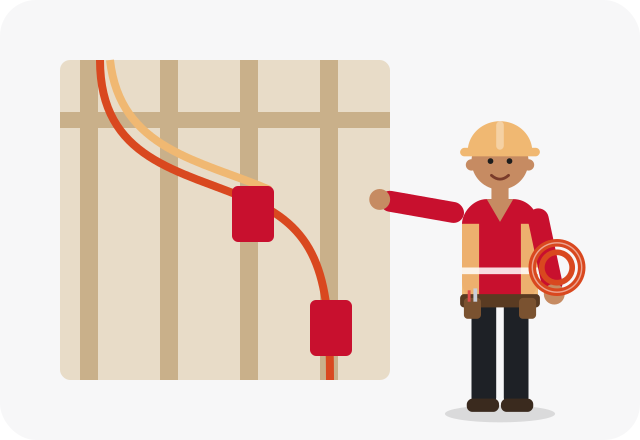
The electrician plans the route, checks panel capacity, and fishes cable through walls and ceilings through small access holes where possible. Connections are made in boxes, devices are installed, and circuits are tested for polarity, ground and proper protection. A permit may be required depending on the scope; check with your city or county.
- Available panel capacity and breaker spaces
- Correct wire gauge for the breaker and the load
- Box fill and securely mounted boxes
- Proper grounding and polarity at every device
- GFCI and AFCI protection where required
Safety first. Don't open outlet or switch boxes or cut into walls near wiring. Avoid running extension cords under rugs or through doorways as a long-term fix. If a wall, outlet or switch is hot, smoking or sparking and it doesn't stop, leave and call 911.
How it usually works
Call to describe the project
Explain what you want powered or what's wrong. You'll be connected with a local electrician.
Walkthrough and plan
The electrician checks the panel, the route and any permit needs.
Wiring and devices
Cable is run, connections made in boxes, and outlets, switches or fixtures installed.
Test and inspect
Every circuit is tested, and an inspection is scheduled if a permit was pulled.
For Birmingham-area homes
Birmingham's hillside homes often have split levels, crawlspaces and tight attics, which shape how cable can be routed. In older houses, it is also common to find a newer circuit spliced into original wiring, and those junctions deserve a closer look whenever new work is planned nearby.
Related electrical problems
Noticing one of these? Each guide explains likely causes and what's safe to check before you call about electrical wiring.